.png)
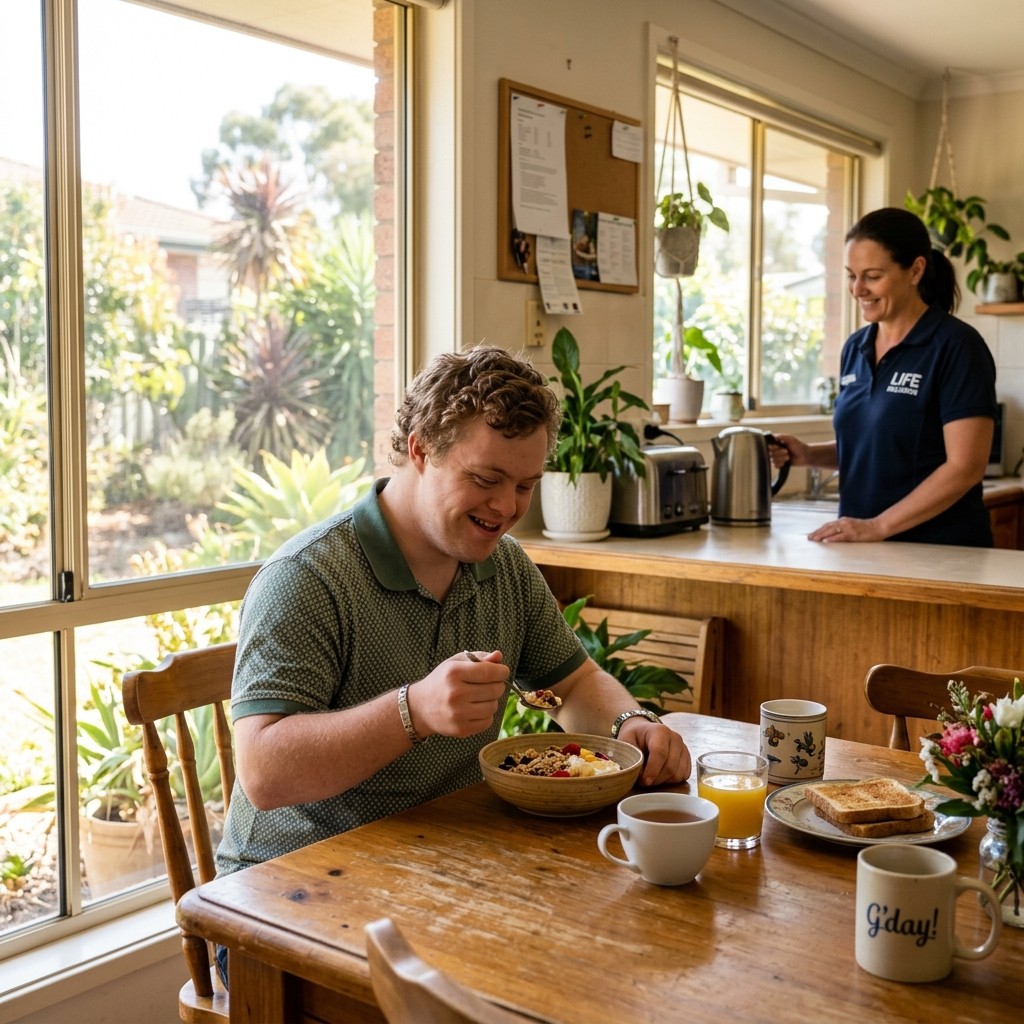
Daily Living Support that fits the rhythm of your day.
Steady, dignified help with the everyday — from getting out of bed to settling in for the night — delivered by support workers who actually get to know you.
Support that fits the rhythm of your life — not the other way around.
Daily Living Support is the foundation of a lot of NDIS plans for a reason — it's the support that quietly makes the rest of life possible. At UCCS, we think of it less as a list of tasks and more as a partnership: we show up regularly, learn how you like things done, and help you keep the rhythm of a day that feels like yours.
Some people we work with want a hand with one tricky part of the morning. Others want a steady worker alongside them through most of the day. Both are welcome here. We start by listening — to you, your family or guardian, and the people who already know you well — and then we build a routine that respects your preferences, your communication style and your sensory needs.
Across every shift, we aim for the same thing: practical help delivered warmly, in a way that builds your confidence rather than chipping away at it. Independence isn't a finish line. It's the small choices we protect every single day.

Building life skills, one routine at a time.
“Independence isn't a finish line — it's the small choices we protect every single day.”
— How we think about Daily Living Support
Practical, person-centred support — mixed to suit you.
Daily Living Support looks different for everyone — that's the point. Here are some of the supports that often sit inside this service, mixed and matched to suit you.
Morning and evening routines
Getting up, getting dressed, breakfast, medication prompts, winding down at night. Predictable, calm routines that reduce stress and start (and end) the day well.
Meal planning and cooking
From a shared shopping list to side-by-side cooking, we help you eat the way you want to eat — with as much or as little support as you need that week.
Personal care prompts
Gentle prompts and hands-on support for showering, grooming, dental care and dressing — always with privacy, choice and consent at the centre.
Skill-building, woven in
We look for natural moments to practise a new skill — paying at the till, using a microwave safely, organising the week — so growth happens through real life, not drills.
Getting out and about
Appointments, errands, a walk to the park or the bus to TAFE. We support you to do the things on your plan and the things that simply make a good day.
Quiet safety in the background
Medication prompts, allergy awareness, safe-use of appliances and a sensible eye on wellbeing — woven in without making you feel watched or managed.

You're welcome here.
Daily Living Support is a fit for people living with intellectual disability, autism and related conditions who want a reliable hand with everyday life. That might be a teenager building confidence after school, an adult living in their own place for the first time, or someone whose support needs have shifted after a change at home.
We support people across a wide range of communication styles — verbal, AAC, gestural, written — and we adapt our pace and our language to suit. If you're new to NDIS support, or you've had a tough run with previous providers, we're happy to start small and build trust at your speed.
- Adults living independently or with family
- Young people transitioning from school or school-leaver supports
- People with sensory sensitivities or anxiety around new routines
- AAC users and people who communicate non-verbally
- Participants moving between Core supports and SIL
- People returning to support after a break
How it fits your NDIS plan.
UCCS is a registered NDIS provider. We support participants however their funding is managed — self-managed, plan-managed or NDIA-managed — and we're happy to walk through what's possible under your plan, without jargon.

Registered with the NDIS Quality and Safeguards Commission, audited against the NDIS Practice Standards and bound by the NDIS Code of Conduct.
Daily Living Support is typically funded from the Core Supports budget under 'Assistance with Daily Life' (line items in the 01_011 group). Your plan will set out how many hours of support are available each week or fortnight and what they can be used for.
Because Core funding is flexible, we can usually combine Daily Living with Community Participation, Transport or Household Tasks across the same week — without you having to re-justify each shift. We'll help you map your hours sensibly so nothing is wasted, and we'll never push for more hours than you genuinely need.
UCCS is a registered NDIS provider. We support participants however their funding is managed — self-managed, plan-managed or NDIA-managed — and claim directly through the NDIS portal where that applies. We provide clear, itemised invoices and are happy to liaise with your plan manager or support coordinator. If you're not sure how your plan is managed, we can help you find out — no pressure, no jargon.
A clear, unhurried five-step path.
We move at your pace. Every step is consent-led and reviewable — if something isn't working, we change it.
Listen
We start by hearing your story — what's working, what isn't, and what you'd like more of.
Understand
We map needs, goals, preferences, sensory and communication style, and any clinical context.
Plan together
We draft a support plan with you (and family, where you want them involved) — workers, hours, routines.
Deliver
Consistent workers, clear handovers, dignified support. We sweat the small stuff so you don't have to.
Review
Regular check-ins, and an open invitation to change anything. Plans should grow with the person.
Communication, your way.
A glimpse of an everyday shift.
Here's a sample weekday for a fictional participant we'll call Jess — a young adult with autism living in a shared home. The shift is delivered by Mia, her regular support worker. Names and details are illustrative.
Mia lets herself in quietly and starts the kettle. Jess prefers the lamp on rather than the overhead light first thing. They greet each other in their usual way — a wave and a 'morning, Jess' — no pressure to chat.
Breakfast together. Jess is working on pouring her own cereal without spilling — Mia stands back, ready to help only if asked. They check the visual schedule on the fridge for what the day looks like.
Off to the GP appointment. Mia drove, but Jess paid the parking with her own card — a small thing, but a confidence win. In the waiting room, Mia keeps the noise-reducing headphones nearby just in case.
A quick shop on the way home. Jess uses her picture list to find three items. Mia hangs back at the end of the aisle so Jess can ask the shop assistant herself if she wants to.
Lunch and quiet time. Mia tidies the kitchen, prepares tonight's chicken so it's ready to cook, and writes a short shift note Jess can read with her parents later.
Nothing here is dramatic. That's the point. Good Daily Living Support is unspectacular by design — predictable, respectful and tuned to the person. The progress shows up over months: Jess answering the receptionist herself, cooking dinner most nights, asking for a different kind of cereal on the shopping list. Small steps, real life.
Common questions, answered honestly.
Can't see your question? Email us at info@unlimitedcommunitycare.com.au and we'll come back to you.
Related supports that often go hand in hand.
Household Tasks
Practical help around the home — cleaning, laundry, meal prep — done with you, not for you.
Learn morePersonal Care
Respectful, dignified personal care delivered with consent and care at every step.
Learn moreCommunity Participation
Get out and connect — classes, groups, volunteering and the local things you love.
Learn moreLet's talk about what support could look like for you.
A friendly, no-pressure chat — we'll listen, answer your questions, and only suggest support that genuinely fits.